World on the Brink
China’s export controls continued to impact rare earth trade flows in September 2026
In September 2026, President Trump and Chinese President Xi met as the United States and China extended their pause on certain trade actions through January 10, 2027.

Associate Director of Research and Analysis

Senior Research & Analysis Advisor

Senior Vice President, Research & Analysis
In September 2026, President Trump and Chinese President Xi met as the United States and China extended their pause on certain trade actions through January 10, 2027. The extension maintains the suspension of China’s expanded October 2025 rare earth export restrictions, but leaves its April 2025 export licensing requirements on minerals such as yttrium in place.
Silverado’s latest report, which primarily covers imports that entered the U.S. in the leadup to the meeting between President Trump and President Xi on September 23-25, 2026 (as most trade data lag by a month or more), finds that China’s global exports of export-controlled rare earth compounds and metals in September 2026 remained well below historical levels. China did export a significant quantity of yttrium oxide to the United States, though yttrium exports to the United States overall remain well below historical levels so far this year. China continued to export a significant quantity of rare earth magnets globally, though exports to the United States in 2026 remain below 2024 levels on a year-to-date basis.
China’s exports to the United States of export-controlled compounds and metals increased in September 2026
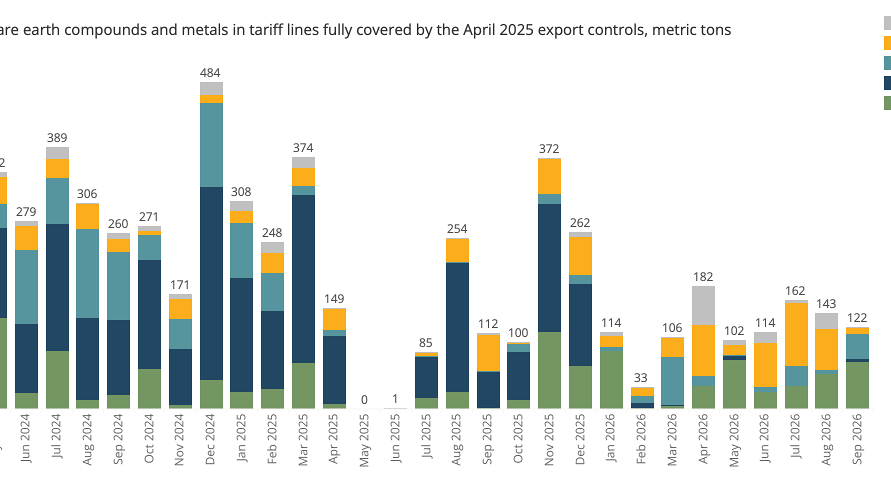
China’s exports of export-controlled rare earth compounds and metals to the United States increased from 6 metric tons in August to 38 metric tons in September 2026, reaching the lower end of pre-export-control monthly levels. This increase was largely driven by renewed shipments of yttrium oxide (though there were no shipments of yttrium carbonate) and continued exports of lutetium oxide, while exports of other controlled rare earth compounds and metals remained at zero.
September marked the second-highest monthly export volume to the United States since China implemented its export controls in April 2025, surpassed only by March 2026. Despite this increase, shipments remained below most pre-export-control monthly levels, highlighting the continued volatility and reduced overall volume of China’s exports of these materials to the United States.
EU Becomes Largest Destination as Exports to South Korea Decline
China’s global exports of controlled rare earth compounds and metals declined from 143 metric tons in August to 122 metric tons in September 2026, remaining well below historical levels. Exports to South Korea, which had been a major destination for these materials, declined substantially in September, while the European Union became the largest global destination for China’s exports. Despite this shift, shipments to the EU remained below levels recorded in most months prior to the implementation of export controls in April 2025.
Meanwhile, China’s exports of controlled rare earth compounds and metals to Japan remained minimal in September 2026, despite China shipping to Japan for the first time in three months. This continues a broader trend of sharply reduced exports following the additional restrictions imposed on shipments to Japan in January 2026. Although Japan was previously a significant destination for these materials, shipments have remained near zero in recent months and well below historical levels.
China’s Rare Earth Magnet Exports to the United States Recover, but Remain Below 2024 Levels
In September 2026, China’s exports of rare earth magnets to the United States reached typical historical monthly levels for the second time in three months, signaling a partial recovery in U.S.-bound shipments. However, despite this recent increase, cumulative exports to the United States during January–September 2026 totaled 4,637 metric tons, approximately 15 percent below the 5,478 metric tons exported during the same period in 2024.
In contrast, China’s exports of rare earth magnets to other major destinations have generally exceeded pre-export control levels. Exports to the EU, China’s largest destination for rare earth magnets, increased by approximately 11 percent during January–September 2026 compared to the same period in 2024, while exports to South Korea increased by 33 percent. Among the major individual export destinations shown below, the United States was the only market to receive a smaller volume of rare earth magnets during January–September 2026 than during the same period in 2024.